
Nobody’s perfect, not even Mister Sun.
Misses Home Power and I LOVE solar. We put solar panels on our first home, our tiny home, our car, our solar oven, our laundry line, our calculator… even our plants are solar powered! I believe solar power has the power to make life better for just about everyone, in a multitude of ways. Better finances, more powerful homes, a more efficient and resilient grid, and a cleaner world. Still, solar isn’t for everyone and worse, solar has a dark side. Sure, photovoltaics magically turn sunshine into tree-huggin, money-saving electricity, but nothing’s free in life (not even free energy). So without further ado, let’s peek behind the curtain and unveil clean energy’s dirty little secrets (and how you can fix them).
Read more: The Dark Side of Solar
THE COST
Despite decades of exponential price declines since the days when only NASA could afford solar, the pricetag on solar can still be a little intimidating. The dirty secret here is that solar hardware is actually pretty cheap now. Solar panels, inverters and other hardware generally amount to 25-30% of the cost of an typical residential system, with the rest being mostly labor.
And since the “Inflation Reduction” Act, solar hardware prices have risen for the first time in decades, driving up the cost of installation by more than 4%, even with a decline in labor and other costs (including installer profit).
Confusing the matter further is that according to Lazard’s 2023 Levelized Cost of Energy report, solar is the cheapest energy source at the utility-scale, but the most expensive at residential scale. Uh, no thanks?
SOLUTION: Stay focused on the bottom line. Saving money (and the planet) is the easy part once you’ve determined that solar is right for you. Not only is solar vastly cleaner than virtually any other power source, it’s probably still cheaper than what you plug your toaster into. And while solar has seen price inflation, grid-sourced energy has too, a whopping 20% from June 2021 to June 2023. Experts predict above-average inflation in energy prices to continue. Meanwhile, solar payments should be lower than your power bill and eventually come to an end. After that, the power is free for years ever after.
THE DIY SOLUTION: If you LOVE doing DIY projects and are comfortable with roofing and electrical work, yes you can save thousands (check out our DIY solar guide). But you also risk creating mouldering leaks in your roof, electrocuting yourself, starting your house on fire, voiding warrantees, giving up a few weekends and possibly falling off your house and trying to explain all of that to your spouse. And for what? Solar will already save you serious money anyway (otherwise you wouldn’t be doing it). The only other major construction projects with such bragging rights are insulation, windows and heat pumps. But if the pricetag of solar scares you, maybe it’d help to finance it. Just beware of…
PREDATORY LENDERS
When Misses HomePower and I had our first photovoltaic system installed a couple decades back solar financing was virtually non-existant. Want a $120k RV or jet skis at 2.75% with zero down? Absolutely! Solar panels that will literally pay for themselves…? Anyone…? Wow, not even a cricket chirp?
We finally convinced a local bank to take our money after even our credit unions let us down. Nowadays there are TONS of solar loan options, so consider yourself lucky, because when I was a kid there WERE no solar loans except from the mob and Umpqua Bank! Umpqua Bank had cookies and a no knee-capping policy, so we went with them.
BUT… while the new solar lenders brag about “amazing” low rates, when you see the fees attached you might prefer the mafia. I’ve seen them above 25% of the loan value, basically consuming your entire tax credit from the “Inflation Reduction” Act. (This environmental profiteering is a big part of why I left solar sales.)
SOLUTION: Talk to an accountant and/or crunch the numbers on any loan presented to you. And remember that you aren’t limited to the “in-house” loans, so shop around for a loan from your bank and use that to pay cash for the solar. You can save THOUSANDS. Also, make sure early payoff is allowed without penalty on any loan you find. Or if you’ve got cash laying around, maybe just paying cash is your best bet (actually use a check or something. Nobody’s going to take a $20G pile of money.)

Congrats! You squeaked past a bad loan with your tax incentives in-tact! Now, on with solar’s dirty little secrets!
HAZARDOUS Solar WASTE & LABOR Concerns
As with any manufacturing, solar panels do have some environmental and labor costs:
- Water use: The production of solar panels requires a whole lot of water.
- Air pollution: The manufacturing process releases pollutants into the air, such as sulfur dioxide, nitrogen oxides, and VOC’s.
- Toxic waste: The manufacturing process involves heavy metals (lead, cadmium, arsenic), various chemicals, including acids and hydrogen fluoride.
- Habitat loss: Mining materials for solar panels can lead to habitat loss and/or degradation.
- A recycling problem (that’s being remedied now, and won’t be your problem for decades anyway).
- And then there are the labor practices in China, where LOTS of solar equipment is made.
SOLUTION: The good news is that these environmental costs ares generally less destructive per megawatt than the costs of equivalent fossil fuel use. If you’re replacing coal, natural gas, charging your EV with your newfound power, you are now rolling in greenie points. Also, buying American-made equipment is required for the federal tax credits, so you’re supporting better jobs and getting the best panels and best warranties in return.
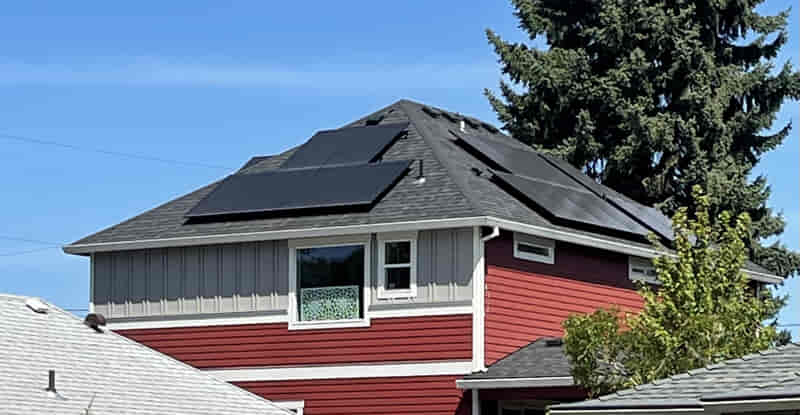
A ROOF FACE ONLY A MOTHER COULD LOVE
Some of us find the polished surface of a solar panel quite pleasant, but it’s fair to say that they don’t match every architectural style. The pragmatist in me says “it’s just a frikkin roof”, but the former student of architecture in me cringes at some jobs, and I’ve met people in both camps. What’s important to you?
SOLUTION: Don’t look up. Haha. I joke. Installers might be able to make adjustments in favor of aesthetics, so it’s worth asking. While most solar panels are installed in either landscape or portrait orientation, there’s no reason they couldn’t be installed in a herring-bone configuration or parquet. Integrated solar roofing tiles like Tesla’s are lovely, but much more expensive (although that will net you a bigger tax write-off if you can use it).
You might also consider installing home battery backup with less solar. Batteries are much easier to hide, and can give you a lot of the benefits of solar (cheaper power, tax credits, environmental benefits) and even some that solar can’t, like power during a blackout, or high voltage EV fast-charging. Stay tuned for our guide on home power back-up, covering what you really need (batteries that don’t self-combust), what you don’t (whole-house backup) and more.
Why the sun Not Working?
It’s shocking, it’s ugly, but it’s true. When the power goes out so does the sun. Well, not the sun, but your solar. Actually, your solar panels keep working fine, but you can’t have the electricity because of rules. You see, regulations require that a system be designed to shut down during a power outage, and for good reason. You’re connected to the grid. When the grid goes down, utility workers need to know which parts are energized. Unfortunately, this means that even if the sun is out, you’ll be just as bummed as everyone else during a power outage.
SOLUTION: When the grid goes off, go off-grid with batteries! I’m a big fan of battery-centric home power systems. Now you can breeze through blackouts without fretting every time you have to open the fridge, use a medical device, turn on the heat pump or make a call.
Some electric vehicles can even power your house during an outage. Very fancy, but see our article on lithium hogs to see if it’s worth it to you.
THE RHYTHM OF NATURE
Solar panels produce electricity during the day, but household electricity demand is highest in the evening. See a problem? (HINT: The sun went down and you’re trying to air-fry tater-tots, right when your utility’s working the hardest (and charging the most). A little gloomy overcast can exacerbate the mismatch even more. Solar panels still work on overcast days, but their efficiency will obviously be reduced, even as you’re turning on the heat and lights
SOLUTION: Again, batteries allow you to use power asynchronously from when you or the grid generate it. And since many utilities charge lower rates at off-peak hours, you can fill up then and save money. So while the pricetag of batteries is nothing to sneeze at, as with solar they can help pay for themselves.
CONCLUSION
So there it is, the dirt on what is perhaps the cleanest source of electricity next to rubbing a balloon on your head (static, dude). I hope I haven’t scared you away, because I want to make sunworshippers out of everyone. As lots of folks are finding out, solar can be a brilliant move that makes life better. If you’re curious about powering YOUR life with an evolved and modern home power system, get in touch. I love talking with folks about this stuff and helping them make awesome decisions that make life great!
Stay in touch!
James


